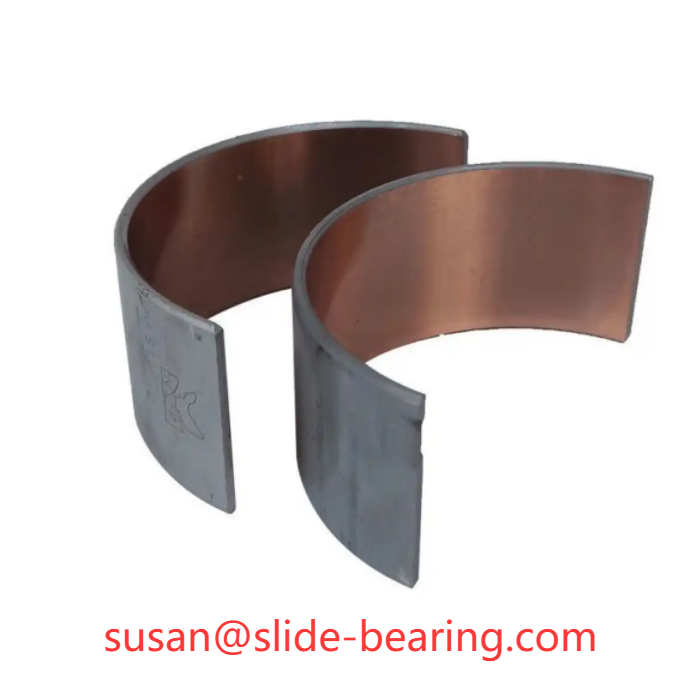
Solid Lubrication Bushings
2026-01-15
1. Definition & Material Design
Solid lubrication bushings utilize embedded solid lubricants (e.g., graphite, PTFE, MoS₂) within a metal matrix to achieve maintenance-free operation8. Common material configurations include:
· Base Alloys: CuZn25Al5Mn4Fe3 (high-strength brass) with hardness >200 HB for heavy loads
· Lubricant Integration: Graphite (5–15% vol.) dispersed in sintered bronze or brass matrices for friction reduction
2. Manufacturing Processes
00001. Cold Rolling: Precision shaping of CuSn8 bronze strips into cylindrical bushings with overlapping seams for structural stability
00002. Powder Metallurgy: Sintering copper alloy powders with solid lubricant additives to form porous, self-lubricating structures
00003. Surface Treatments:
· PTFE coatings for enhanced corrosion resistance in marine environments
· Nickel plating to improve surface hardness (HV 300–400)
3. Performance Characteristics
|
Parameter
|
Value
|
|
Static Load Capacity
|
80–120 N/mm²
|
|
Dynamic Friction Coefficient
|
0.08–0.12 (dry conditions)
|
|
Temperature Tolerance
|
-50°C to +250°C (intermittent)
|
|
Wear Rate
|
≤0.1 mm/1000h under 50 N/mm² load
|
4. Industrial Applications
· Construction Machinery: Excavator pivot joints requiring shock absorption and high static loads
· Marine Equipment: Propeller shaft sleeves with seawater corrosion resistance
· Automotive Systems: EV suspension linkages for lightweight and maintenance-free operation
5. Market Trends & Innovations (2025)
00001. Eco-Friendly Lubricants: Bio-based coatings (e.g., cellulose-PTFE blends) to meet sustainability regulations
00002. Hybrid Materials: Aluminum-brass composites (C6782) reducing component weight by 25% in automotive applications
00003. Smart Monitoring: IoT-enabled bushings with embedded wear sensors for predictive maintenance
6. Conclusion
Solid lubrication bushings demonstrate exceptional adaptability in extreme environments, driven by advancements in material science and manufacturing techniques47. Future development will prioritize environmental compliance and smart integration for Industry 4.0 applications
Welcome to inquiry with us if you are required similar products.
Contact: Susan Shi
Wechat/whatsapp: +8613517489983




 (Chat Online)
-connecting-rod-bearing.png)